

by Asghar Seyed-Gohrab
In technical usage, the term Iran carries various connotations, linguistically, geographically, politically, and culturally. From a linguistic perspective, it refers to Iranian languages, a branch of the Indo-European language family. These languages are believed to have evolved from a common proto-language, giving rise to many contemporary languages with similar semantic, syntactic and morphological features. Their shared origin is evident in words such as pedar (“father”), mādar (“mother”), barādar (“brother”) and dokhtar (“daughter”) which are similar in various Indo-European languages.[1]
Linguistic designations correspond to groups and cultural identities in the area in which Iranian languages are spoken. This area stretches from the north of China, through the Pamir Mountains in Tajikistan, and on to Afghanistan, Central Asia, Iran, the Caucasus, part of today’s Turkey, Iraq and the Persian Gulf. In these areas, cultural, scholarly and literary activities have taken place in various Iranian languages, especially in Persian, which served as a lingua franca.
In this context, particularly in Iran, there are three cultures, shaping society. Iranian peoples have a different worldview than their neighbours. One motif in artistic, literary, mythologic and topographical sources is the world’s “Seven Regions” (haft keshvar). In this model, the best place on earth to live is the land of Iran which is the centre, while other regions are peripheral, smaller and less inhabitable.[2] The kings of the other six regions are vassals to the Iranian King. This is reflected in his title, Shahanshah or “king of kings.” This worldview recurs in several sources. Nezāmi’s (d. 1209) Haft Peykar (“Seven Beauties”), a poem of some 5,000 couplets, is one literary masterpiece that refers to Iran as the heart of the world.
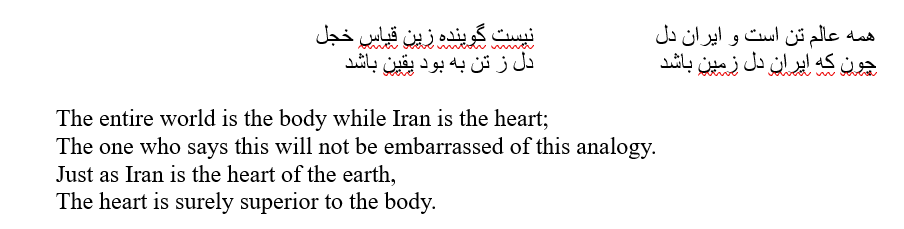
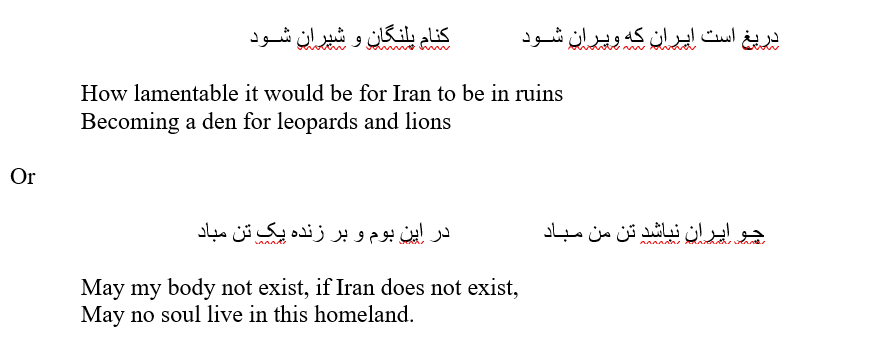
Contemporary Iranians know these lines by heart. They cite them without necessarily knowing this system of the “Seven Regions,” yet aware that the name “Iran” has a burden of meaning from classical Persian. One of the reasons that Reza Shah (r. 1925-1941) changed the official name of Persia to Iran in 1935 was that Iranians called their country Iran. The name-change also had to do with Reza Shah’s sympathies with Nazi Germany.[3] One of the major literary works in Persian is Ferdowsi’s massive Shāh-nāme (The Epic of the Kings), composed in the year 1010, which brings together mythology, legends, history, codes of ethics and moral systems, religion, and proper conduct. This and several other masterpieces shaped societies and functioned as models for generations of scholars, poets and artists.[4] This epic refers to the term Iran in various contexts. We see heroes who offer their lives for the homeland. We see how Iran is personified as an ensouled being who should be protected from harm. Iranians draw lessons of compatriotism from this poem. Perhaps the most quoted lines in contemporary Iran are:
With the arrival of Islam, many cultures in the Middle East lost their identities to the Islamic-Arabic culture, but the Persians protected their language, culture and history. Persians immensely contributed to the Islamic civilization, transforming a parochial faith to a universal religion, writing books in Arabic on a wide range of subjects such as cosmology, medicine, grammar, philosophy, ethics and literary subjects.[5] One can say that Islam created a symbiosis among various cultures in this period, and people of diverse ethnic backgrounds contributed to this young culture.
In this context, particularly in Iran, there are three “cultures” shaping society. The notion of the “three cultures” was coined by Abdolkarim Soroush, who conceptualized it as the national, Shiite and European traditions, each essential for understanding modern Iran.[6] My interpretation differs slightly. I would like to refer to the pre-Islamic cultural ideal, reflected in the Shāh-nāme, although that was written in the Islamic period, the Sunni/mystic and Shiite religious culture, and European political-philosophical elements. This reframing emphasizes the deep historical continuity of Iranian civilization, extending beyond the Islamic period, while including the modern period with European civilisation as part of Iranian culture. In Iranian society, these cultural layers cannot be seen as separate. Although they compete, they have become deeply intertwined and are interdependent. Each has reinforced the features of the other. Marginalising any one of them disrupts the balance of Iran’s cultural dynamics. (I will return to this presently)
The sense of surviving any invading adversary is very strong in Iran. Iran has been invaded by the Greeks, the Muslim Arabs, and the Mongols, but Iran overcame these assaults. Ahmad Ashraf roots this resilience in pride in the Persian cultural heritage. He says, “A deep feeling of pride in Iran’s cultural heritage with Persian literature as its core element, a consciousness of continuity in a long and distinctive history of the country—particularly, a belief in the ability of the Iranian peoples to survive recurrent periods of upheavals—have served as a cohesive force to resist and ultimately overcome divisive currents.”[7] As the eminent scholar of Persian Studies, Ehsan Yarshater (1920-2018), states, “Persian literature is the jewel in the crown of the Persian culture.”[8] This is especially true of Persian poetry with its mesmerising topics, inimitable imagery and unparalleled volumes. The Persian language functioned as a lingua franca from Belgrade in the Balkans to the Bay of Bengal till the 19th century. It was the language of culture, spirituality and administration for several dynasties. The masterpieces written in Persian reflect the cultural features of these vast areas and how people from these regions contributed to the Persian culture.
The situation changed markedly with the rise of the nation-states. Russia, with its superior military forces, attacked Iran several times in the 19th century, annexing vast territories in the Caucasus and Central Asia.[9] Iran was militarily underdeveloped. By the time reforms were implemented, two imperial powers, Russia and Great Britain, had dominated Persia. A striking illustration of Iran’s weakened position is the history of concessions. In 1901, a sixty-year oil monopoly, tax-free, was granted to the William Knox D’Arcy.[10] When the British discovered oil in 1907, they exploited this, allocating only 16 percent of the profits to Iran, for a period of sixty years. The deal was adjusted somewhat, and extended for another sixty years, in 1933.
In 1951, when Mohammad Mosaddeq (1882-1967) came to power as Prime Minister, he wanted to change this unfair deal. Suggestions for a 50-50 deal were made but Churchill did not accept that, as Great Britain depended heavily on the oil for their navy. The Iranian Parliament passed an oil nationalization bill on March 20, 1951, but the British protested, boycotting Iranian oil exports. The British Intelligence Service (MI6), together with the CIA, orchestrated a coup in 1953, toppling Mosaddeq and installing the Shah who was removed from power as absolute monarch.[11] Iranians still blame the British and Americans for the end of constitutional rule. Some even wonder whether the 1979 Revolution was a result of the 1953 coup.
The encounter with Western political philosophy introduced a new cultural layer in Iran. The Pahlavi dynasty combined this with Iran’s pre-Islamic heritage to lead Iran into a new era, modelling Iran on Europe. In simple terms, the Pahlavi period can be characterised as an age of rapid westernization while foregrounding a distinctly Persian cultural heritage. At the same time, the resulting marginalization of Islam, combined with the broader context of Western political influence, created a generation of Iranians with anti-western sentiments and pro-religious sympathies, who supported the Iranian Revolution of 1979. The establishment of the Islamic Republic reversed this trajectory by downplaying both Iran’s pre-Islamic heritage and Western cultural influence, in favour of an Islamist ideology. This policy has failed to meet the expectations of the majority of the Iranians. Even during critical moments such as the Iran-Iraq war (1980-1988), the limits of relying solely on Islamic heritage became visible. Relying solely on Iran’s Islamic culture has not worked in the last 47 years. In the latest war, even the religious hardliners of the regime invoke pre-Islamic symbols from the Achaemenian (700 to 330 BC) and Sassanian (224–650 CE) periods and the epic poetry of Ferdowsi’s Shāh-nāme to mobilise public sentiments against the USA and Israel.[12] One hardliner, Mohammad-Bagher Ghalibaf, who participated in negotiations between Iran and the USA in Pakistan, cited poetry from Ferdowsi on social media:
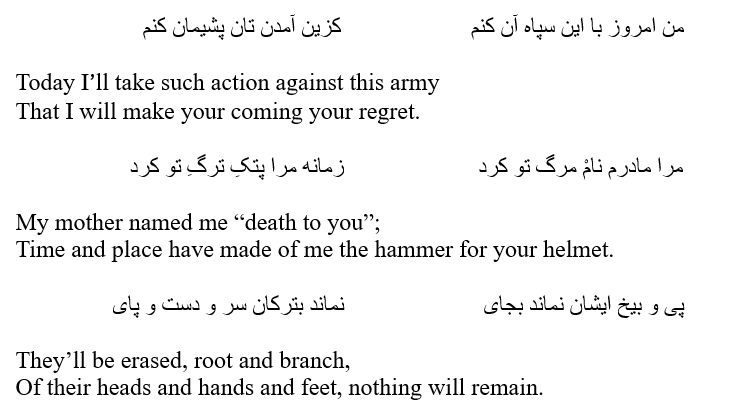
Such recourse to pre-Islamic Persian culture by the regime shows that leading members of the regime realise that their Islamist ideology has failed. They cannot have the support of the people without respecting pre-Islamic Persian culture. Even with these two cultures (Islam and Persian), the Iranian government cannot be successful unless they include western culture, creating a balance between the “Three Cultures” that have created modern Iranian identity.
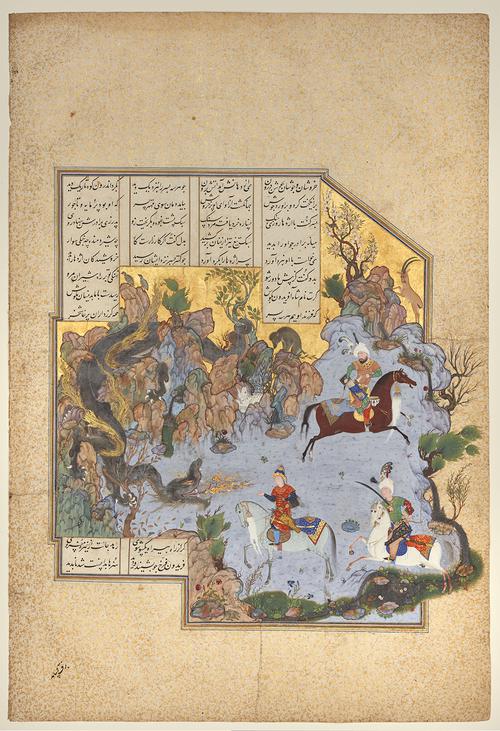
Image: “Faridun Tests his Sons”, Folio form the Shahnameh (Book of Kings) of Shah Tahmasp. Aga Khan Museum (Accession Number: AKM903)
© Asghar Seyed-Gohrab and the Beyond Sharia ERC Project, 2026. This project has received funding from the European Research Council (ERC) under the European Union’s Horizon 2020 research and innovation programme (Grant agreement No. 101020403). Any unlicensed use of this blog without written permission from the author and the Beyond Sharia ERC Project is prohibited. Any use of this blog should give full credit to Asghar Seyed-Gohrab and the Beyond Sharia ERC Project.
Bibliography and further reading
Amanat, A., A Modern History, New Haven & London: Yale University Press, 2017.
Ashraf, A., in Encyclopædia Iranica, s.v. Iranian Identity, i. Perspectives.
Ferdowsi, Shahnameh: The Persian Book of Kings, translated by Dick Davis, New York: Penguin Books, 2016.
Fragner, B., Die “Persophonie”: Regionalität, Identität und Sprachkontakt in der Geschichte Asiens, Berlin: ANOR, 1999.
Frye, R.N., in Encyclopædia Iranica, s.v. Iran V. Peoples of Iran (1): A General Survey.
Frye, R.N., The Golden Age of Persia: The Arabs in the East, London, 1975, reprinted 2000.
Green, N., The Persianate World: The Frontiers of a Eurasian Lingua Franca, Oakland, California: University of California Press, 2019.
Llewellyn-Jones, L., Persians: The Age of the Great Kings, London: Wildfire, 2022. (Dutch translation, De Perzen: Een nieuwe geschiedenis van de eerste supermacht ter wereld, vertaald door Aad Janssen en Pon Ruiter, Amsterdam: Nieuw Amsterdam, 2022).
Perso-Russian relationship see Encyclopædia Iranica: https://www.iranicaonline.org/articles/russia-index/
Planhol, X., de., in Encyclopædia Iranica, s.v. Geography i. Evolution of Geographical Knowledge.
Shahbazi, S., in Encyclopædia Iranica, s.v. Haft Kešvar.
Soroush, A., “The Three Cultures,” in Reason, Freedom, & Democracy in Islam: Essential Writings of ‘Abdolkarim Soroush, Translated, Edited, and with a Critical Introduction by Mahmoud Sadri and Ahmad Sadri, Oxford: Oxford University Press, pp. 156-170.
[1] See Richard N. Frye, in Encyclopædia Iranica, s.v. Iran V. Peoples of Iran (1): A General Survey.
[2] S. Shahbazi, in Encyclopædia Iranica, s.v. Haft Kešvar. Also see Xavier de Planhol, in Encyclopædia Iranica, s.v. Geography i. Evolution of geographical knowledge.
[3] See Abbas Amanat, A Modern History, New Haven & London: Yale University Press, 2017, p. 494.
[4] See the edited volume by Nile Green, The Persianate World: The Frontiers of a Eurasian Lingua Franca, Oakland, California: University of California Press, 2019. There are several other mongraphs on this topic, including Bert Fragner, Die “Persophonie”: Regionalität, Identität und Sprachkontakt in der Geschichte Asiens, Berlin: ANOR, 1999. For a translation of Ferdowsi’s epic see Shahnameh: The Persian Book of Kings, translated by Dick Davis, New York: Penguin Books, 2016.
[5] See R.N. Frye, The Golden Age of Persia: The Arabs in the East, London, 1975, reprinted 2000.
[6] Abdolkarim Soroush, “The Three Cultures,” in Reason, Freedom, & Democracy in Islam: Essential Writings of ‘Abdolkarim Soroush, Translated, Edited, and with a Critical Introduction by Mahmoud Sadri and Ahmad Sadri, Oxford: Oxford University Press, pp. 156-170.
[7] A. Ashraf, in Encyclopædia Iranica, s.v. Iranian Identity, i. Perspectives.
[8] See his introductions to each of the 20-volume history entitled, A History of Persian Literature.
[9] For a series of articles on the Perso-Russian relationship see Encyclopædia Iranica: https://www.iranicaonline.org/articles/russia-index/
[10] Abbas Amanat, Iran: A Modern History, pp. 519-520.
[11] Abbas Amanat, Iran: A Modern History, pp. 551-558; for an award-winning documentary on this pivotal event see Taghi Amirani, Coup 1953.
[12] For an excellent monograph on Achaemenids and their legacies in modern Iran see Lloyd Llewellyn-Jones, Persians: The Age of the Great Kings, London: Wildfire, 2022.
[*] On 28 April 2026, the Royal Netherlands Academy of Arts and Sciences (KNAW) organized the event “Encountering Iran: Politics Culture, and International Relations.” I gave a short opening address on the notion of Iran. At the request of several participants, I now publish this in written form.